Athletic directors and facilities managers usually start shopping for a stadium sound system the same way: the old system is failing, game-day announcements are unintelligible on one side of the field, and the first quotes that come back vary so widely it’s hard to tell what’s actually being compared. This guide explains what a stadium system has to do, which decisions drive the budget, and where schools most often overspend — based on how CIAVL’s in-house design team engineers these systems.
What a Stadium Sound System Actually Has to Do
The job is intelligibility, not volume. Every seat — home stands, visitor stands, track level — should hear announcements clearly at a comfortable level. A system that has to be driven hard to reach the far bleachers is a failed design, even if it’s loud: the home crowd gets blasted, the visitor side still struggles to make out words, and the equipment wears out faster running at its limits.
Outdoor systems also fight physics that indoor rooms don’t. Sound loses energy crossing hundreds of feet of open air, and temperature and humidity change how far it carries. Weather exposure rules out most consumer and portable equipment entirely — stadium loudspeakers, rigging, and wiring need to be rated for years outdoors.
The Decisions That Drive the Budget
1. Speaker layout — and whether the visitor side needs its own speakers. The single biggest cost fork in a stadium project is whether speakers go on one side of the field or both. Speakers on the visitor side need mounts, conduit, power, and signal cable — and if that infrastructure doesn’t exist, it usually means trenching under the track. That’s civil work: cutting, boring, restoring, and often permitting. A properly engineered long-throw design can cover both sides from the home side alone, eliminating the entire category.
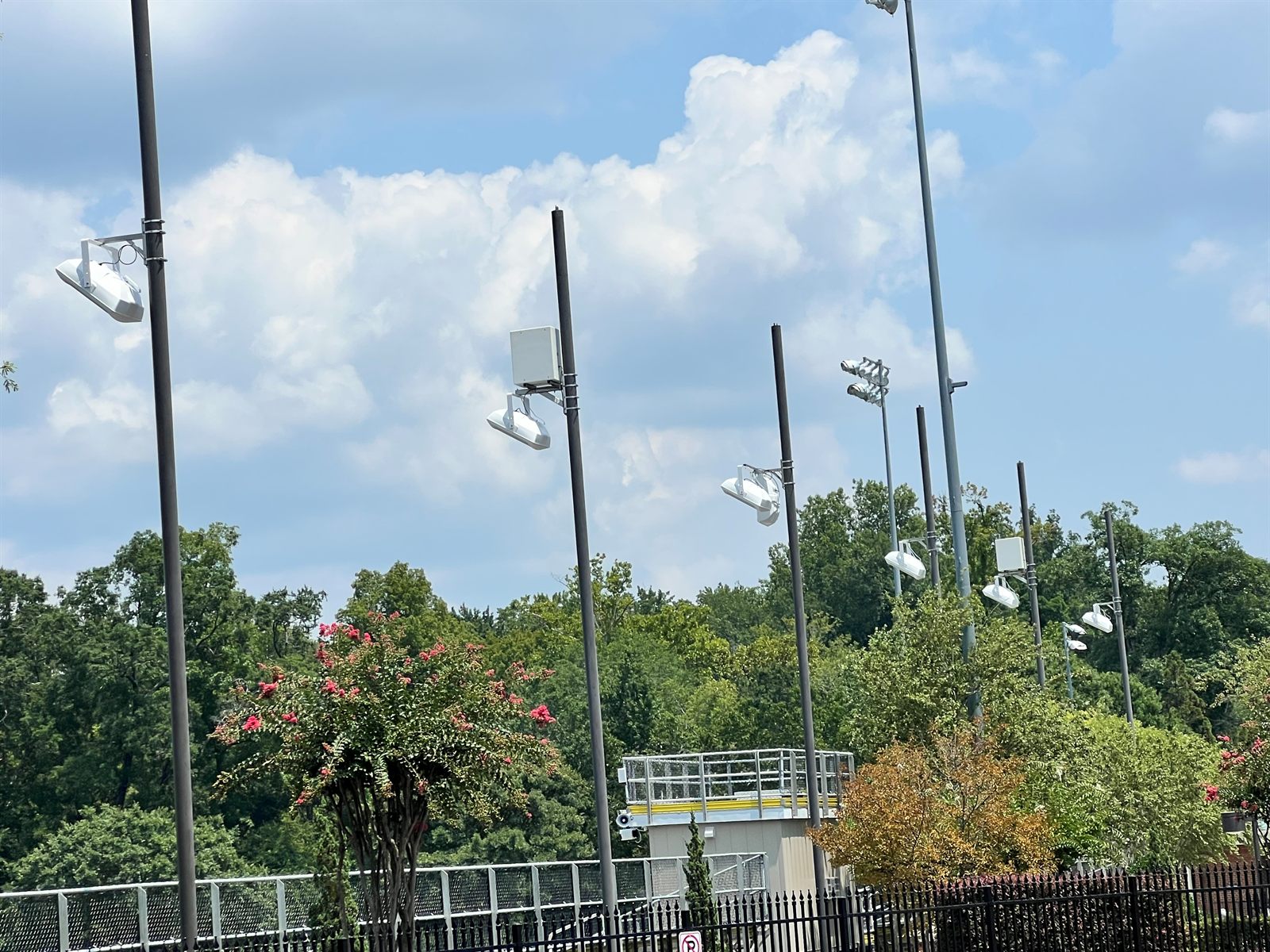
At North Raleigh Christian Academy’s football stadium, we covered both sets of stands from nine home-side loudspeakers — one long-throw box aimed across the field for the visitor stands, six point-source boxes for home coverage, and two weather-rated subwoofers. No visitor-side mounts, no conduit, no trenching under the track.
2. Mounting positions. The press box roof is the natural anchor point for a stadium array, but it isn’t always available — at NRCA the coaches’ box sat directly above it. Pole-mounted arrays solve this, but pole height, placement, and rigging have to be engineered against the coverage model, not chosen by eye.
3. Acoustic modeling before purchase. Any integrator can list speakers on a quote. The question to ask is whether the layout has been modeled — coverage predicted at real listening positions, under realistic outdoor conditions, before anything is ordered. For NRCA we modeled the full array in Danley Prism 3D at site-specific temperature and humidity and validated it against sixteen measurement points across both seating zones before installation. Modeling is how a one-sided design covering both stands gets verified up front instead of “fixed” with volume after the fact.
4. Amplification and processing. Loudspeakers, amplifiers, and DSP should be matched — ideally from the same engineering ecosystem — so each box gets the power and tuning it was designed for. Mismatched amplification is a common source of underperformance in stadium systems that look fine on paper.
5. The announcer station. The gear at the top of the stands matters as much as the speakers on poles: a mixer your announcer can actually operate, a reliable gooseneck mic for announcements, wireless handhelds with enough RF range for on-field use, and a clean equipment rack. This is also where schools with aging systems get an immediate quality-of-life improvement for volunteers and staff.
Where Schools Overspend
- Trenching that engineering could have avoided. If a quote includes visitor-side infrastructure, ask whether a long-throw design from the home side was modeled first.
- More boxes instead of better placement. Overlapping, poorly aimed speakers create the muddy, echo-prone sound many stadiums suffer from. Fewer, correctly aimed loudspeakers routinely outperform a larger count.
- Replacing hardware without fixing the design. If the old layout was wrong, new speakers in the same positions inherit the same problems.
What the Process Should Look Like
A stadium project done in the right order: site walk and requirements, acoustic modeling and design, a proposal you can evaluate line by line, installation scheduled around your season, commissioning and tuning, and training for the people who will run it on Friday nights. CIAVL self-performs every one of those steps with our own staff — no subcontractors — from our offices in Winston-Salem, Raleigh, and Ocala, FL.
Planning a stadium or athletic facility upgrade? See our sports facility AV solutions or request a consultation — we’ll model your stadium before recommending a single speaker.